


Page 17 - S.H. Raza || SOJOURN || The Arts Trust
P. 17
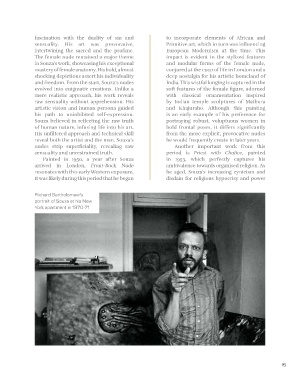
Raza with the Progressives in
 Mumbai in the 1940s


 of France, from representational landscapes to metaphysical   Raza’s artistic aptitude appeared early, at the    commercial streets, Raza painted several gouache
 abstraction, is truly phenomenal. There was one incident that   Higher Secondary School in Damoh, Madhya Pradesh.   works that captured the city’s spirit. During this period,
 Raza always shared and recalled from his childhood, which   With the guidance of his art teacher, Shri Daryav Singh   he also attended evening classes at the Mohan  Art Club
 was from the late 1920s. It was symbolic in understanding   Rathore, he designed the first edition cover of the school   with painter Mohan Kulkarni, who kindly waived off his
 his later engagement with the bindu. When he struggled to   magazine, Pushpanjali. His love for poetry, music, literature,   registration fee.
 concentrate in school, Shri Nandlalji Jharia, his teacher, drew   Hindi, and Indian culture was nurtured by another great   Raza began gaining recognition after exhibiting two
 a simple black dot on the wall, asking him to focus until his   teacher, Gauri Shankar.  These early mentors helped him   unframed gouaches at the Art Society of India’s show at
 mind stilled.  This moment, which seemed ordinary at the   discover the beginnings of the artist he would eventually   Cama Hall. Here, the critic, Rudolf von Leyden, praised
 time, planted a seed that Raza himself would later describe as   become.  Their words stayed with him like softly turning   his works as the most significant in the exhibition. Raza
 foundational to his life’s artistic direction.  pages. Colour, sound, and verse began to weave his inner   spent the next few years travelling widely across India,
 world.  And from those gentle origins, a lifelong vision       including Rajasthan, Gujarat, Madhya Pradesh, and the
 was born, one that would one day illuminate the canvas         south, absorbing artistic and cultural influences. In 1944,
 of modern Indian art. Guided by the formative influences       Walter Langhammer, newly-appointed  Art Director of
 Untitled (Houses), 18.2 x 19.2 in, gouache & ink on paper, 1953  and encouragement from his teachers, Raza  stepped   The Times of India, offered Raza his studio. He guided his
 forward from inspiration into rigorous artistic training. In   artistic development and introduced him to the works of
 the late 1930s, he attended the Nagpur School of  Art,         the  Impressionists,  the Bengal Renaissance, and thinkers
 studying drawing and painting under the guidance of M V        like Coomaraswamy and Herbert Read. Langhammer
 Athawale. After completing his studies, he taught drawing      also connected him to  collector Emmanuel Schlesinger,
 at  the Gondia Municipal  High  School  and later at  the      who later became a key patron. Raza received a silver
 Government Normal School in Amravati. The 1940s were           medal from the Bombay  Art Society  in 1946,  but the
 a time of political and cultural transformation. These were    following years brought both personal loss and historic
 the final years of the freedom struggle; the dynamic energy    milestones: the passing of his mother in 1947 and India’s
 of the growing city gave young artists a fertile ground for    independence.  That very same year, he held his first
 experimentation. Fatima, his wife, along with the rest of her   solo exhibition.  This event, at the Bombay  Art  Society
 family, moved to Pakistan after the Partition of India, while   Salon,  and inaugurated by Rudolf von Leyden, marked an
 Raza remained in India.                                        important early milestone in Raza’s career.
 In 1943, Raza moved to Bombay (now Mumbai)
 and joined the Sir J J School of  Art. During the same
 time, he was also working at Express Block Studio, as   The Invisible Cross   The Bombay Years & the Progressive Artists’ Group
 a designer.  The studio’s owners, Jalil Sahib and  Ashfaq   51.3 x 35 in (130 x 89 cm)  A defining chapter in Raza’s artistic life emerged when
 Husain, were generous and allowed him to use the   Oil on canvas  he co-founded the Progressive  Artists’ Group (PAG) in
 space freely for three years. From a window overlooking   1970  1947, with F N Souza and H A Gade. This group, which
 Pherozeshah Mehta  Road, one of Bombay’s busy                  soon expanded to include M F Husain,  Tyeb Mehta,


 16                                                                                                                  17

